How we helped a client refinance a $6.5 Million Landed Property

Home loan refinancing in Singapore is usually straightforward, but what happens when you also need to restructure the ownership of the property, extend the loan tenure and reduce monthly repayments? All while trying to overcome a financing challenge.
On this page
Jump to
Menu
On this page
Jump to
The situation
Our client owned a landed property in District 5, and the current market value was $6.5mil at the time of writing.
She approached us with 2 objectives:
- Reduce the financial stress
- Refinance the property
Refinancing the property was the easy part, we just had to find a bank offering the right package with the right interest rates for her. However, as she was in her 60s, her remaining loan tenure could not be extended further than the remaining 8 years of loan tenure available to her.
With a remaining loan balance of $2,196,000 and today’s interest rate of 1.35%, her monthly average mortgage repayments would be $24,000.
The property was previously jointly owned with her ex-husband. Following their divorce, she bought over his share and became the sole owner. To ease the financial stress, she decided that she was going to sell a 40% ownership of the home to her son and daughter-in-law.
1Reduce the financial stress
Since her son and daughter-in-law were both in their 30s, adding them as co-owners allowed the bank to assess the eligible tenure of the loan favourably, using the Income-Weighted Average Age (IWAA) of all borrowers.
To calculate the new loan tenure with the addition of the couple, we will use the IWAA formula:
In this scenario, there are 3 parties, so the calculation would look like this:
Based on the calculation, the IWAA would be rounded up to 48 years. As mortgage loans have a maximum age limit of 65 years, the remaining eligible loan tenure would be 17 years (65-48=17).
By increasing the loan tenure, the monthly repayment can potentially decrease to $12,053, based on today’s current interest rate (1.35%) and the current outstanding loan balance.
With the addition of younger co-owners, the increase in loan tenure spreads the outstanding loan over a longer repayment period, lowering the monthly repayments.
By selling 40% ownership of the property to the couple, our client would be able to get back some of the cash that’s tied up in the property.
| Current Market Value | $6,500,000 |
|---|---|
| Remaining Loan Balance | $2,196,000 |
| 40% of property ownership | $2,600,000 |
Here’s where it gets complicated. The refinancing bank needs to calculate the total financing amount, which will include 75% of the couple’s 40% share and the remaining loan balance.
The couple’s financing portion will look like this, which would cover 40% of the loan.
| 40% of property ownership | $2,600,000 |
|---|---|
| 5% Cash | $130,000 |
| 20% Cash and/or CPF | $520,000 |
| 75% Loan | $1,950,000 |
The total financing amount would be calculated accordingly, which adds up to $3,267,600.
Client's loan + Couple's loan = (60% of remaining loan) + $1,950,000
If you’re wondering why the new loan is not just $2,196,000, here’s why:
The outstanding loan of $2,196,000 represents the amount still owed to the bank under the existing mortgage. However, this transaction is not simply a refinancing. It also includes a partial sale of the property.
Our client sold 40% of her ownership in the property, which means that they are not only taking over part of the existing mortgage, but are also purchasing a share of the property. The new financing amount includes the compensation for the share that our client is selling.
The outstanding loan was also based on the property’s value when it was originally financed, and since the market value has appreciated over the years, the value of the 40% share that is sold is higher than before.
The three owners do not hold equal shares in the property, therefore, financing cannot simply be divided into thirds and must be calculated based on each owner’s percentage.
For our client, her compensation for the shares that she sold would total up to:
$130,000+$520,000+($3,267,600-$2,196,000)=$1,721,600.00
This amount would be used to pay off any CPF usage and accrued interest, and also help her ease her overall financial stress.
2Refinance the property
At this stage, we had the total financing amount, but still needed to calculate their affordability - whether they were eligible for the loan under the Total Debt Servicing Ratio (TDSR) framework.
Not sure how much you can borrow?
Use our TDSR calculatorTo calculate this, we can use our TDSR calculator to estimate their affordability. The two primary factors are age and monthly fixed income.
| Age | Age is used to calculate the maximum loan tenure. It is calculated by using the maximum loan servicing age, 65 years old, to subtract your current age. The resulting age is then compared against the maximum loan tenure - up to 35 years for private residential properties and up to 30 years for HDB flats. Your maximum loan tenure will be whichever shorter. Example (Private Property): A 25-year-old will have a maximum loan tenure of 35 years, whereas a 50-year-old would have a maximum loan tenure of 15 years. |
|---|---|
| Monthly Fixed Income | According to MAS guidelines, the TDSR is capped at 55% of your gross monthly income. This means that with a gross monthly income of $8,000, your monthly loan obligations cannot exceed $4,400. Loan repayments include not only your home loan, but also car loans, personal loans, etc. |
With your age and monthly fixed income, the calculator will be able to estimate the maximum loan amount that you can borrow.
Their IWAA, which calculated their average age, showed that their joint age was 47.7 years old, rounded up to 48 years old. This is the number that we will use in the age portion of the calculator. Their joint recognised monthly income totals up to $27,735.
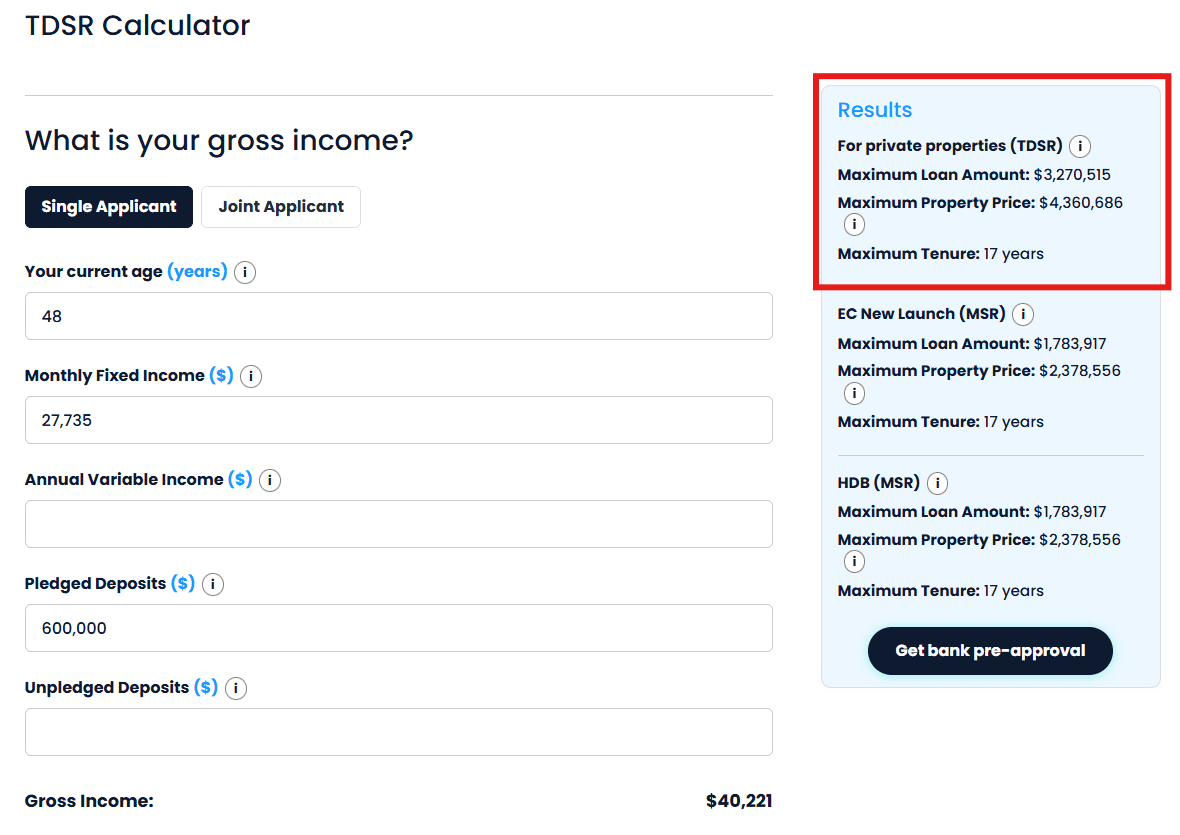
According to the calculator, the maximum loan amount that they were eligible for was $2,255,233, resulting in a shortfall of $1,012,367.
There are a few ways that you can increase your maximum loan amount under the TDSR framework. The most straightforward would be to have a higher fixed salary/income, which is directly related to your TDSR.
However, there are also other factors such as yearly bonuses, pledged and unpledged deposits that can be used to increase your maximum loan amount.
A pledged deposit is basically a fixed amount that will be locked up at the bank as collateral for the loan. As per MAS guidelines, the deposit must be pledged for a minimum of 48 months, or 4 years.
An unpledged deposit is basically savings that will remain in your bank account and are not locked up as collateral for the loan.
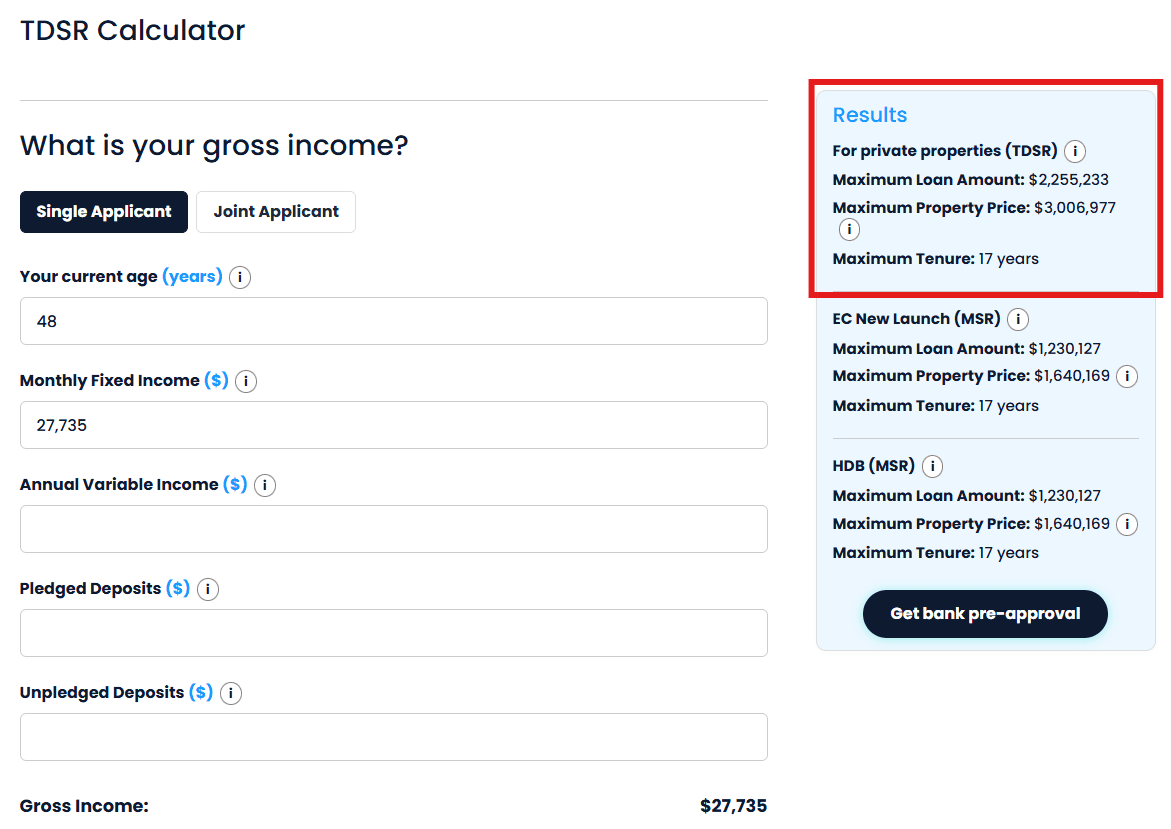
Our client was open to pledging deposits to the bank, which will increase the maximum loan, however, we still needed to calculate the amount needed.
To calculate this, we need the following:
| Shortfall | $1,012,367 |
|---|---|
| Maximum Loan Tenure | 17 years, or 204 months |
| Additional monthly instalment to cover shortfall | $6,848 |
| Additional monthly income needed | $6,848 / 55% (TDSR) = $12,451 |
*The formula used is:
Where:
P = Loan amount
r = Monthly interest rate
n = number of monthly payments
M = Monthly repayment
As the pledged deposit had to remain with the bank for four years, as per MAS guidelines, we can estimate the funds needed by multiplying the additional monthly income needed with the minimum duration. This totalled up to $597,648.
When comparing home loan interest rates in Singapore, the headline rate is just one consideration. The loan package that our client chose had a 2-year lock-in period with interest fixed at 1.35% for the same duration. There was no prepayment allowed, but our client has the option to reprice the loan 1 year from the loan disbursement date.
Looking to refinance?
Compare available home loan packagesOther considerations
There were other fees that our client, her son and daughter-in-law had to take into account.
First, it was the legal fees involved. They had to fork out a total of $6,000 in fees, which can be paid for with your CPF OA. This included, but was not limited to:
- Title search
- Serving of the full redemption notice to the existing bank
- Purchasing agreement
- Writing to CPF regarding the down payment
- Writing to IRAS regarding the stamp duty
Second, the couple had to pay BSD. As they purchased 40% of the property, their share of the house is valued at $2,600,000. At that value, their BSD rate is 5%, which calculates to $130,000.
Lastly, there were also valuation fees, which were about $800 to $900.
In this case, the bank gave our client a cash gift of $2,500, which helped to cover some of the legal costs involved. However, our client needs to maintain a 3-year loan relationship with the bank or the cash gift will be clawed back by the bank.
There was also an additional benefit. As our client pledged funds with the bank, the fixed deposit earns about 1.2% interest P.A.. While the earnings are relatively smaller, it can help to ease a bit of the financial stress.
Conclusion
Every case is different. For this client, we were able to help lessen financial stress by introducing her son and her daughter-in-law as co-owners. As they were also younger, this also allowed for a longer loan tenure, helping to make monthly repayments more manageable.
In most cases, increasing your income through a higher-paying job or additional income streams can improve your financial position over time, refinancing can be time-sensitive. Waiting may mean moving onto higher interest rates once your existing package ends.
If you need assistance, speak to our consultants to weigh your options.
Frequently Asked Questions
What is the TDSR framework?+−
The Total Debt Servicing Ratio (TDSR) is a framework that limits how much of a borrower’s gross monthly income can be used to service their total monthly debt obligations.
The TDSR limit is 55% of gross monthly income and takes into account commitments such as home loans, car loans, personal loans and credit card debt.
How does TDSR affect home loan refinancing in Singapore?+−
When refinancing a home loan, the bank will assess whether you can afford the new loan based on factors such as your income, existing debt obligations and eligible loan tenure.
Even if a refinancing package offers a more attractive interest rate, you will still need to meet the bank’s financing and affordability requirements.
How can I estimate how much home loan I can afford?+−
A mortgage calculator can provide an indicative estimate based on factors such as your age, monthly income, existing debt obligations and loan tenure.
Other financial assets, including pledged and unpledged deposits, may also affect the amount you can borrow.
Can pledged deposits increase my home loan amount?+−
Pledged deposits may be taken into consideration when assessing your income and borrowing capacity. These funds are placed with the bank and locked up as collateral for a specified period.
In the case above, pledged deposits helped the borrowers address the financing shortfall and increase the maximum loan amount they could qualify for.
Does adding a younger co-owner increase the loan tenure?+−
It may, depending on the borrowers and how the bank assesses their ages.
In this case, adding the client’s younger son and daughter-in-law as co-owners allowed the bank to assess the loan tenure using the Income-Weighted Average Age (IWAA) of the borrowers. This resulted in a longer eligible loan tenure and helped reduce the monthly repayments.
When should I consider refinancing my home loan?+−
You may want to review your home loan when your existing package is between 3 to 6 months from the end of the lock-in period.
Refinancing is not always about securing the lowest interest rate. Loan tenure, monthly repayments, lock-in periods, fees and your overall financial situation should also be considered before making a decision.
What costs should I consider when refinancing a home loan?+−
Depending on your circumstances, refinancing may involve legal fees, valuation fees and other transaction costs. If property ownership is also being transferred, additional costs such as Buyer’s Stamp Duty may apply.
Some banks may provide cash incentives or subsidies to offset certain costs, although these may come with conditions such as a minimum loan relationship period.