
What Is a Mortgage Calculator?
A mortgage calculator is a digital tool that estimates monthly housing loan repayments based on several financial inputs. The purpose of the calculator is to provide a preliminary view of how much a borrower may need to pay each month for a property loan.
Many homebuyers use mortgage calculators in Singapore to assess home loan repayments. These tools typically require three main inputs: property price, loan tenure, and interest rate. The calculator then applies a standard amortisation formula to generate an estimate.
The results usually reflect a simplified scenario, as real loan packages may include different structures, such as fixed or floating rates, which can affect the final repayment amount.
How a Home Loan Calculator Works
A home loan calculator works by applying an amortisation formula to determine how a loan is repaid over time. The formula calculates how each monthly payment is divided between principal repayment and interest.
The calculation generally involves three main components:
- Loan amount - the total borrowed after deducting the down payment
- Interest rate - the annual percentage rate applied to the loan
- Loan tenure - the duration of repayment, usually between 20 and 30 years
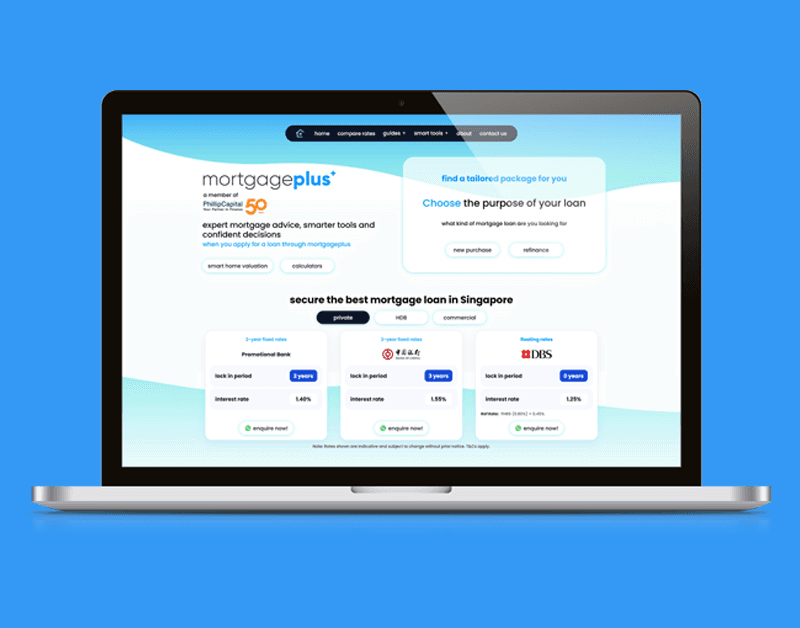
When these variables are entered into the calculator, the system computes the monthly repayment required to gradually reduce the loan balance to zero at the end of the tenure.
Although this process produces a structured estimate, it assumes that the interest rate remains constant and that the loan conditions remain unchanged throughout the repayment period.
Why Mortgage Calculators Provide Estimates Instead of Exact Figures
Mortgage calculators produce estimates because they operate under simplified assumptions rather than the actual loan approval conditions. The final mortgage terms are determined only after a lender evaluates the borrower and the property.
Several factors explain why results from a mortgage calculator may differ from actual repayments:
- Banks apply different interest rate structures for various loan packages
- Mortgage rates may change depending on market conditions
- Loan approval depends on credit assessments and financial profiles
- Certain loan features may alter repayment structures
Because these elements are not always included in the calculator model, the final repayment amount offered by a bank may differ from the initial estimate.
Factors That Influence Mortgage Repayment Accuracy
Several financial and regulatory variables influence mortgage repayment calculations. These variables may change over time or differ between lenders. The most common factors include the following:
Interest Rate Structure
Interest rates determine how much interest accumulates on the loan balance. Some mortgages have fixed rates for a period, while others follow floating benchmarks such as SORA. Since home loan calculators assume a constant rate, the repayment estimate may differ from actual repayments if the rate changes later.
Loan Tenure
Loan tenure affects the monthly payment amount and the total interest paid over time. Longer tenures usually reduce monthly payments but increase total interest costs. Mortgage calculators typically assume the borrower maintains the same tenure throughout the loan term, which may not always be the case in practice.
Loan-to-Value Limits
Loan-to-Value (LTV) limits determine the maximum portion of the property price that a mortgage can finance. In Singapore, LTV limits vary depending on factors such as the number of existing housing loans and borrower eligibility. Calculators may not fully account for these regulatory adjustments.
The Role of Stress Testing for Singapore Housing Loans
Stress testing is a financial assessment used by lenders to evaluate whether borrowers can manage repayments under higher interest rate scenarios. This process is part of responsible lending practices in Singapore.
Banks typically apply stress tests during loan approval. These tests assess repayment ability under conditions such as:
- Higher interest rates than the current market rates
- Reduced income stability
- Changes in repayment obligations
Because mortgage calculators usually do not include stress-testing conditions, their repayment estimates may appear lower than the amounts lenders use during formal assessment.
How Interest Rate Changes Affect Calculator Results
Interest rate movements directly affect mortgage repayment amounts. Even small changes in interest rates can significantly influence monthly payments over a long loan tenure.
Mortgage calculators usually allow users to test different interest rate scenarios. This feature helps borrowers understand how repayments might change if market rates increase or decrease.
However, these projections remain hypothetical. Actual mortgage packages may use variable benchmarks that change periodically in response to financial market conditions.

Common Inputs Required in Mortgage Calculators
Mortgage calculators rely on user inputs to generate repayment estimates. Accurate input data improves the usefulness of the estimate. Typical inputs include the following:
- Property purchase price
- Down payment amount
- Loan tenure in years
- Estimated interest rate
These inputs allow the calculator to approximate the monthly repayment amount and the total interest paid during the loan period. While the results provide useful guidance, they should be treated as planning figures rather than final financial commitments.
Limitations of Online Mortgage Calculators
Online mortgage calculators are designed for simplicity and accessibility. This simplicity also limits how accurately they reflect real loan structures. The most common limitations are as follows:
- Interest rate assumptions may remain constant throughout the loan tenure
- Loan packages with promotional rates may not be represented
- Regulatory constraints affecting loan eligibility may not be included
- Changes in financial circumstances are not factored into the estimate
Due to these limitations, Singapore homebuyers should use a home loan calculator as a budget planning tool rather than as a definitive repayment schedule.
When Mortgage Calculators Are Most Useful
Mortgage calculators are most useful during the early stages of property planning. They allow potential homebuyers to estimate affordability before speaking with lenders. In Singapore, calculators are commonly used for several practical purposes:
- Estimating monthly repayment capacity
- Comparing different loan tenures
- Testing the impact of different interest rate scenarios
- Understanding how down payments influence loan size
These early calculations can help borrowers evaluate financial readiness before progressing to formal loan applications.
How Borrowers Should Interpret Calculator Results
Mortgage calculator results should be interpreted as planning estimates rather than guaranteed repayment amounts. The figures provide a framework for understanding the potential financing costs of a property.
Borrowers can use the results to evaluate financial capacity by considering the following:
- Whether monthly repayments fit within their income level and financial stability
- Whether interest rate changes would significantly affect repayments
- Whether the loan tenure aligns with long-term financial planning
By treating the calculator output as a guide, users can develop more realistic expectations when approaching lenders.
The Difference Between Mortgage Estimates and Loan Approval
Mortgage estimates generated by calculators differ from loan approvals issued by financial institutions. A calculator produces a theoretical repayment model, while a loan approval reflects a lender's formal evaluation. Loan approval typically involves several steps:
- Verification of income and financial obligations
- Assessment of credit history
- Review of property valuation
- Application of regulatory lending frameworks
Because these factors are evaluated individually for each borrower, the final mortgage offer may differ from the estimate produced by a mortgage calculator.
FAQ
- Are mortgage calculators in Singapore reliable?
Mortgage calculators are reliable for producing general estimates of housing loan repayments. They apply standard financial formulas to calculate monthly payments based on the information provided. However, the figures remain approximate because they do not account for lender-specific policies or detailed financial assessments. - Why do bank loan offers differ from calculator estimates?
Bank loan offers differ because lenders evaluate a borrower's income, credit history, and regulatory eligibility before finalising loan terms. They may also apply stress testing and different interest rate structures. These factors are usually not included in standard calculator models. - Can a home loan calculator help Singapore homebuyers predict future repayments?
A home loan calculator cannot predict exact future repayments because interest rates may change over time. Floating mortgage packages follow market benchmarks that fluctuate periodically. The calculator, therefore, provides a static estimate rather than a long-term prediction. - Do mortgage calculators take Singapore lending regulations into account?
Most mortgage calculators include basic assumptions about loan structures, but may not fully account for all regulatory conditions. Lending rules such as loan-to-value limits and financial assessment frameworks may vary depending on borrower circumstances. - Should property buyers rely only on mortgage calculators?
Mortgage calculators should not be the only tool used when planning a property purchase. They provide a starting point for understanding affordability, but should be complemented by financial advice and lender consultations.
Get Expert Home Loan Guidance with mortgageplus
Mortgage calculators in Singapore provide helpful estimates that allow prospective homeowners to understand potential housing loan repayments. By entering key variables such as loan amount, interest rate, and tenure, users can quickly evaluate different financial scenarios.
However, these calculators do not represent final mortgage terms. Actual loan approvals depend on lender evaluations, regulatory requirements, and changing interest rates. For this reason, you should also get guidance from professional mortgage brokers such as mortgageplus before committing to a property purchase. Speak to our advisors!