The Value of Space: Do bigger units still mean lower PSF?

If you could get something for cheaper by buying in bulk, would you? If needed, the answer would probably be yes for a lot of people. In most cases, the more you purchase, the cheaper things can be. Think about bulk discounts, where buying 2 items could get you a 10% discount, but 3 items could get you a 15% discount.
We can also see a similar relationship in property, less straightforward, but similar nonetheless. Traditionally, we are more likely to see larger units commanding a lower PSF, as compared to their smaller counterparts.
So what happens when buyers start placing a greater value on the additional space?
Do larger condos always have a lower PSF in Singapore?
Not always. While larger units traditionally had lower PSF, this relationship between size and PSF can be influenced by other factors, such as price quantum.
When purchasing larger homes, buyers have to commit to a higher overall price. While it is understandable that more area equals to a higher price, there is a limit to how much a buyer can afford. A lower PSF can help to keep the overall price of larger units within a more manageable range.
This also means that while larger units offered more space at a lower PSF, smaller units could still remain attractive to buyers due to the overall lower capital commitment.
On this page
Jump to
Menu
On this page
Jump to
What’s changing in the market
If buyers place greater value on space, will the traditional relationship between unit size and PSF still hold?
Here’s what we found out:
Our methodology
For this analysis, we will only be looking at private residential property transactions across the past 5 years (2021 - 2026). The data is obtained from REALIS, an online platform by URA, updated on 19 August 2026.
The data set was limited to non-landed private residential properties, which included apartments, condominiums and executive condominiums that have exited MOP. Properties that were involved in en bloc transactions were also excluded to allow for a more like-for-like comparison of typical non-landed residential transactions.
Units that were bigger than 500 sqm were not included within this analysis, as units of this size are uncommon. They typically comprise of premium unit types, such as penthouse apartments.
We grouped transactions according to their recorded floor area, and we used median PSF to better represent typical transactions within each unit size.
This analysis instead focuses on more commonly transacted non-landed residential properties to better reflect typical buyer behaviour.
We first analysed the transactions as a whole before separating them by tenure to determine whether the same relationship between unit size and PSF could be observed across freehold properties and leasehold properties.
Definitions:
| Apartments | Smaller-scale private residential developments |
|---|---|
| Freehold* | Properties with freehold tenure or exceptionally long leasehold tenures, such as 999 years and above |
| Leasehold | Properties with shorter leases, primarily around 99 years |
*For the purpose of this analysis, exceptionally long leasehold tenures have been grouped together with freehold properties.
Property layout differs from developer to developer, therefore, for a clearer illustration of the property sizes, here’s how they compare to typical HDB flat sizes.
| Flat Type | Area Range (sqm) |
|---|---|
| 1-ROOM Flats were built before 2010 | 31 |
| 2-ROOM | 35 - 50 |
| 3-ROOM | 60 - 75 |
| 4-ROOM | 80 - 109 |
| 5-ROOM | 99 - 149 |
| EXECUTIVE Flats were built before 2010 | 124 - 243 |
| MULTI-GENERATION Flats were built before 2010 | 132 - 179 |
Note: The range excludes less common models such as the HDB Terraces. Where available, HDB flat sizes are based primarily on flats completed from 2010 onwards to provide a more up-to-date comparison.
Transactions as a whole
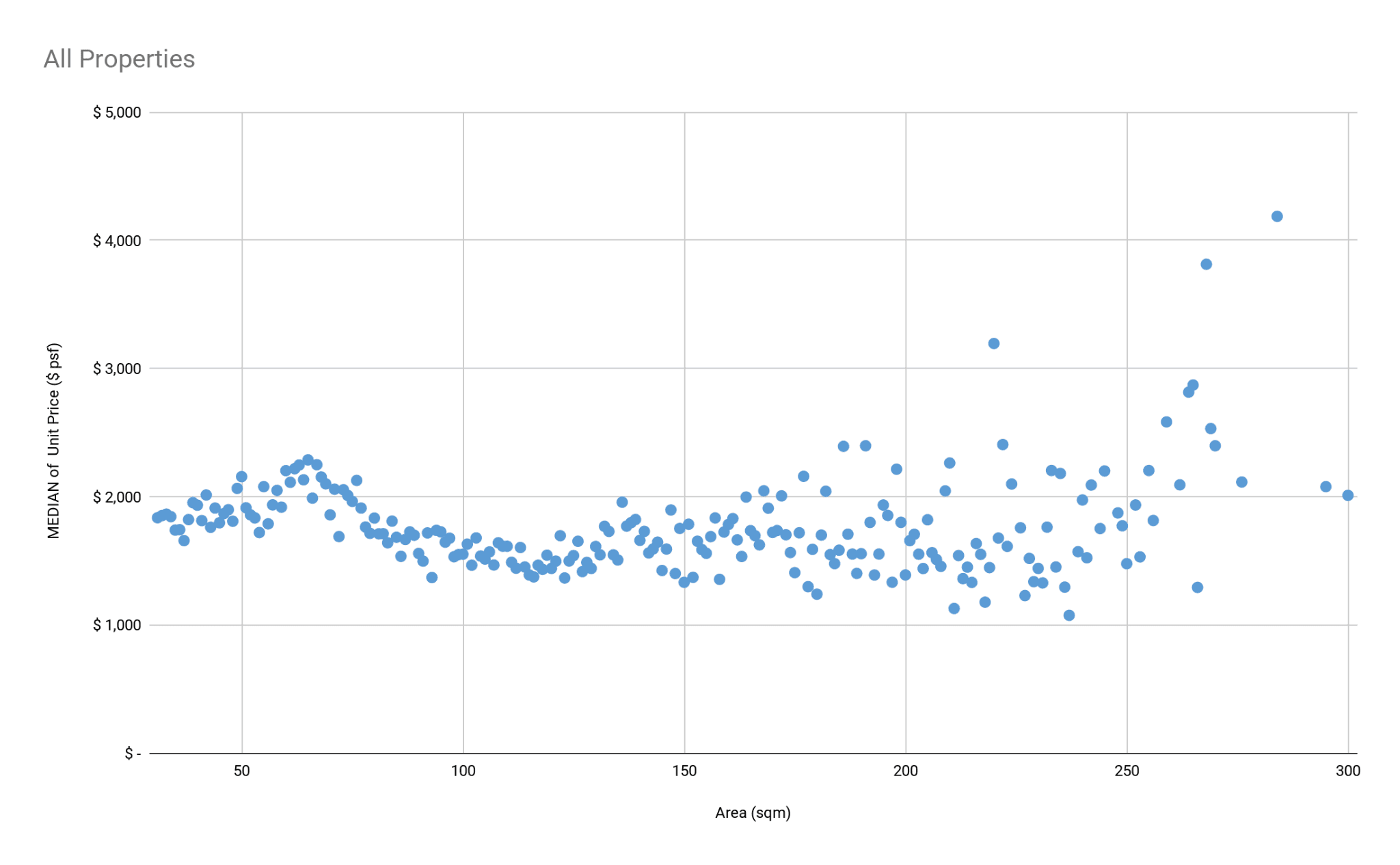
Earlier, we established that larger units traditionally tend to have lower PSF. This trend generally holds for units up to 130 sqm. Beyond that, the relationship becomes less consistent, with the median PSF gradually increasing alongside unit size.
Freehold Properties
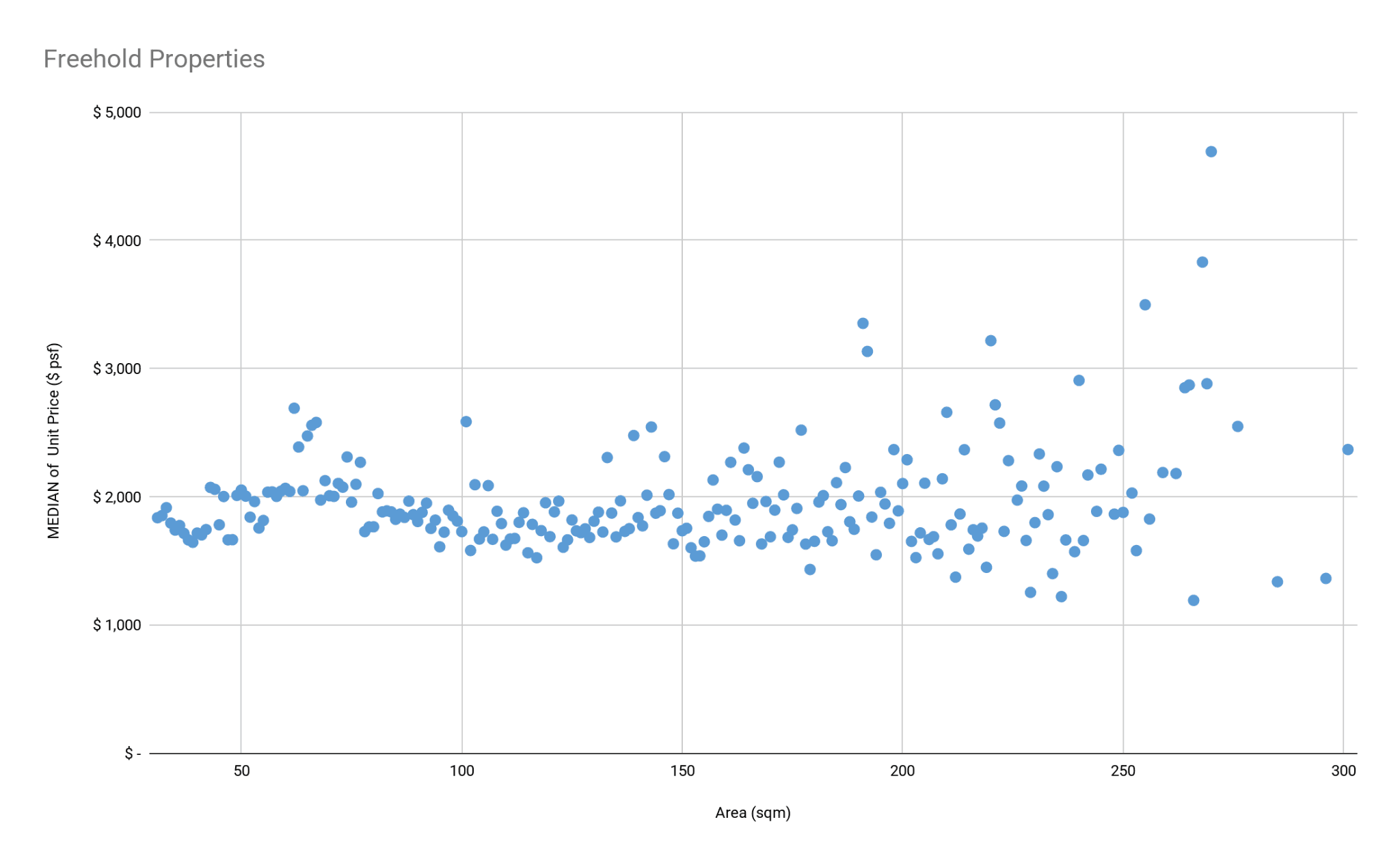
For freehold properties, the trend is less common here, and the PSF is relatively stable across unit sizes. A possible factor could be the tenure of the property, and properties being freehold may influence how much a buyer is willing to pay for a freehold property.
Leasehold Properties
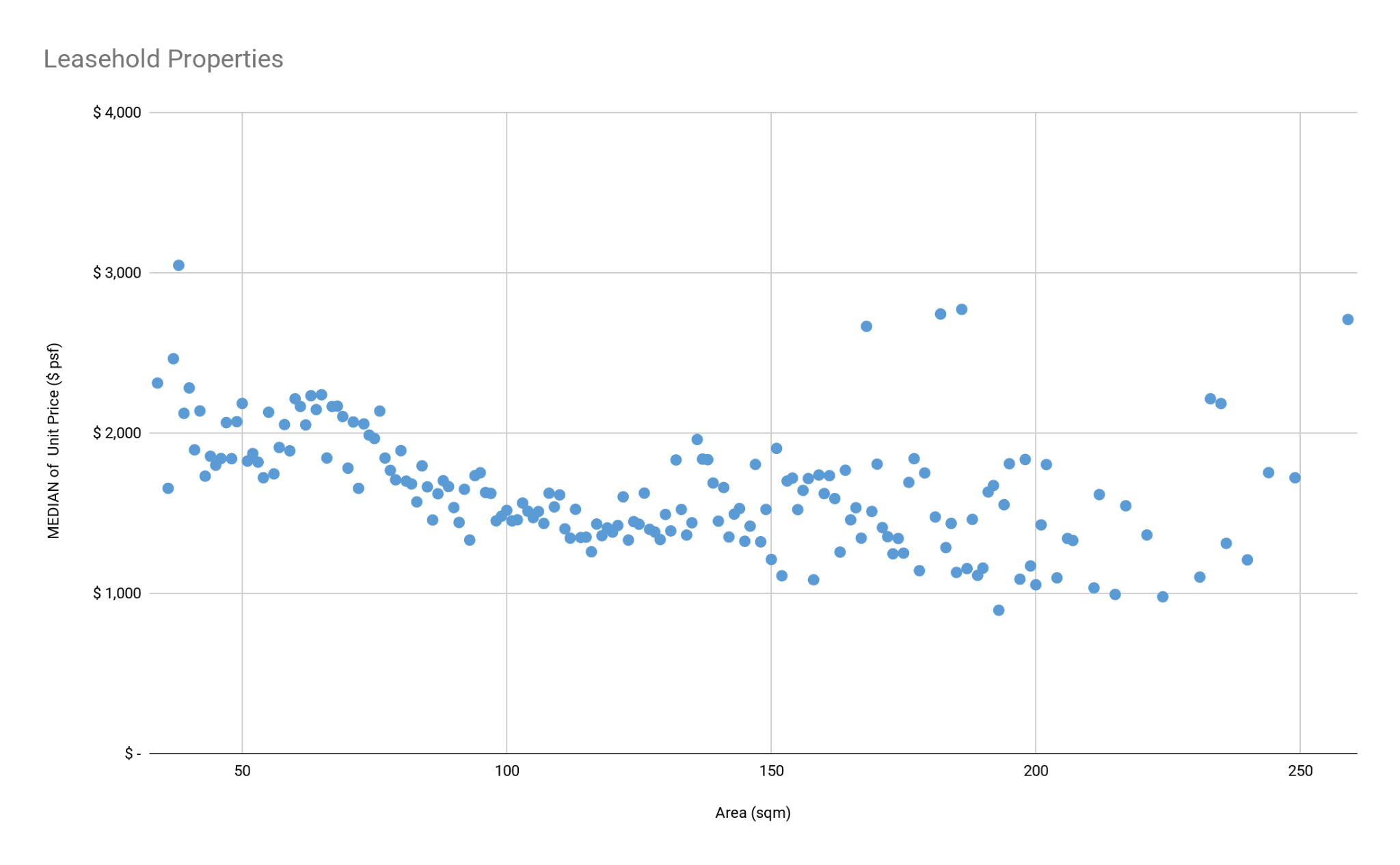
The traditional relationship is more obvious in leasehold properties, however, we see a slight increase in PSF towards units that are 130 sqm and up.
Case Studies
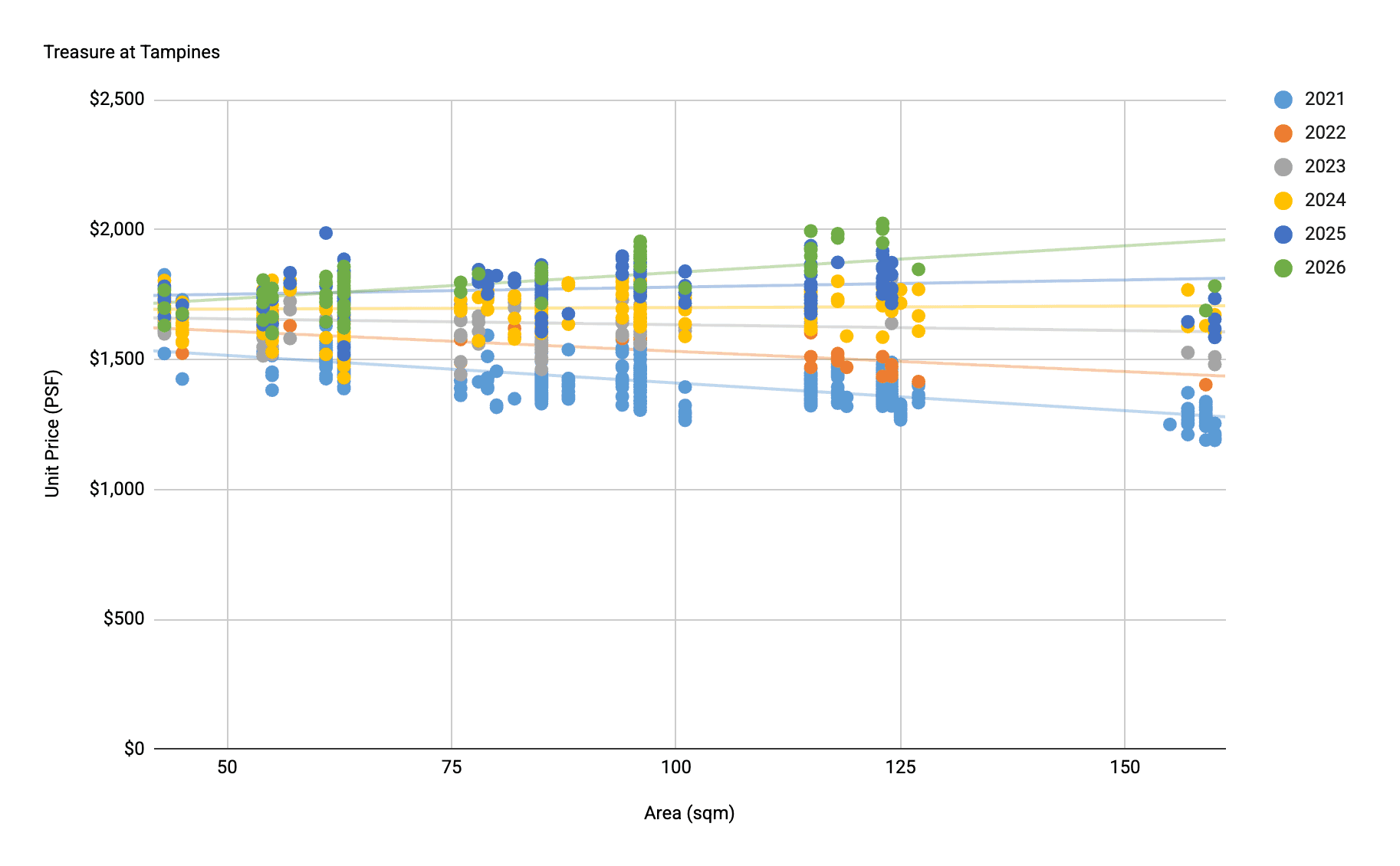
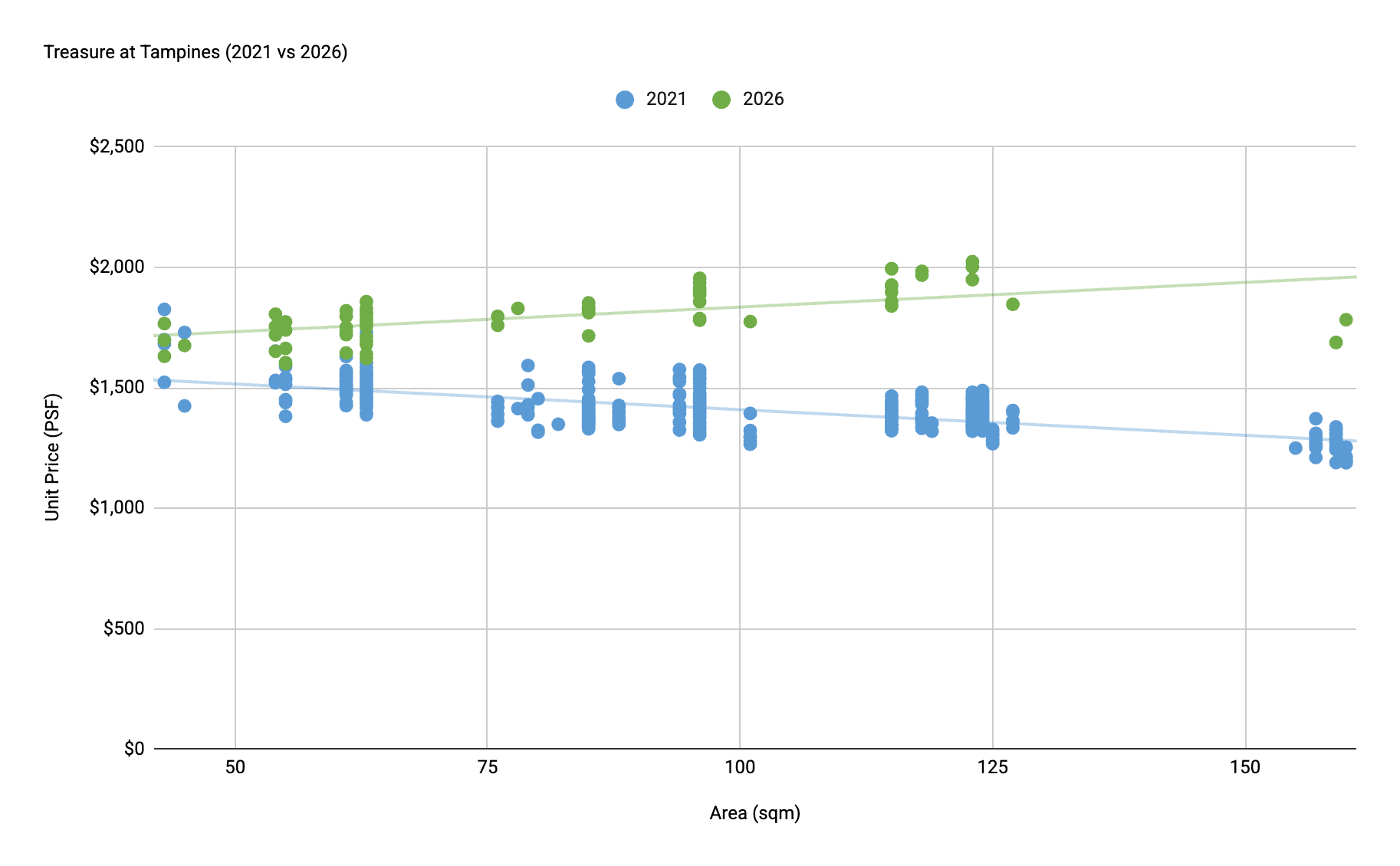
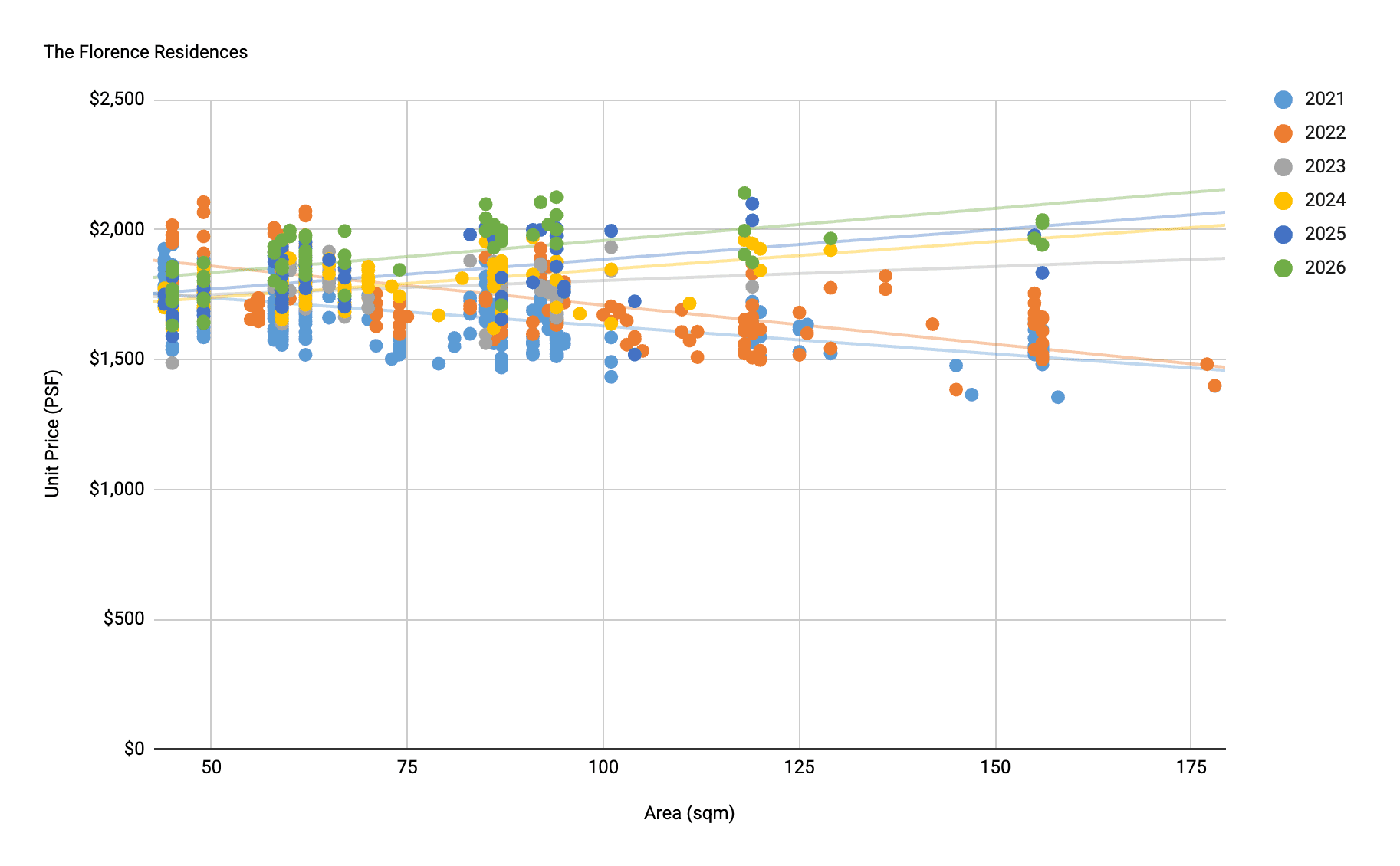
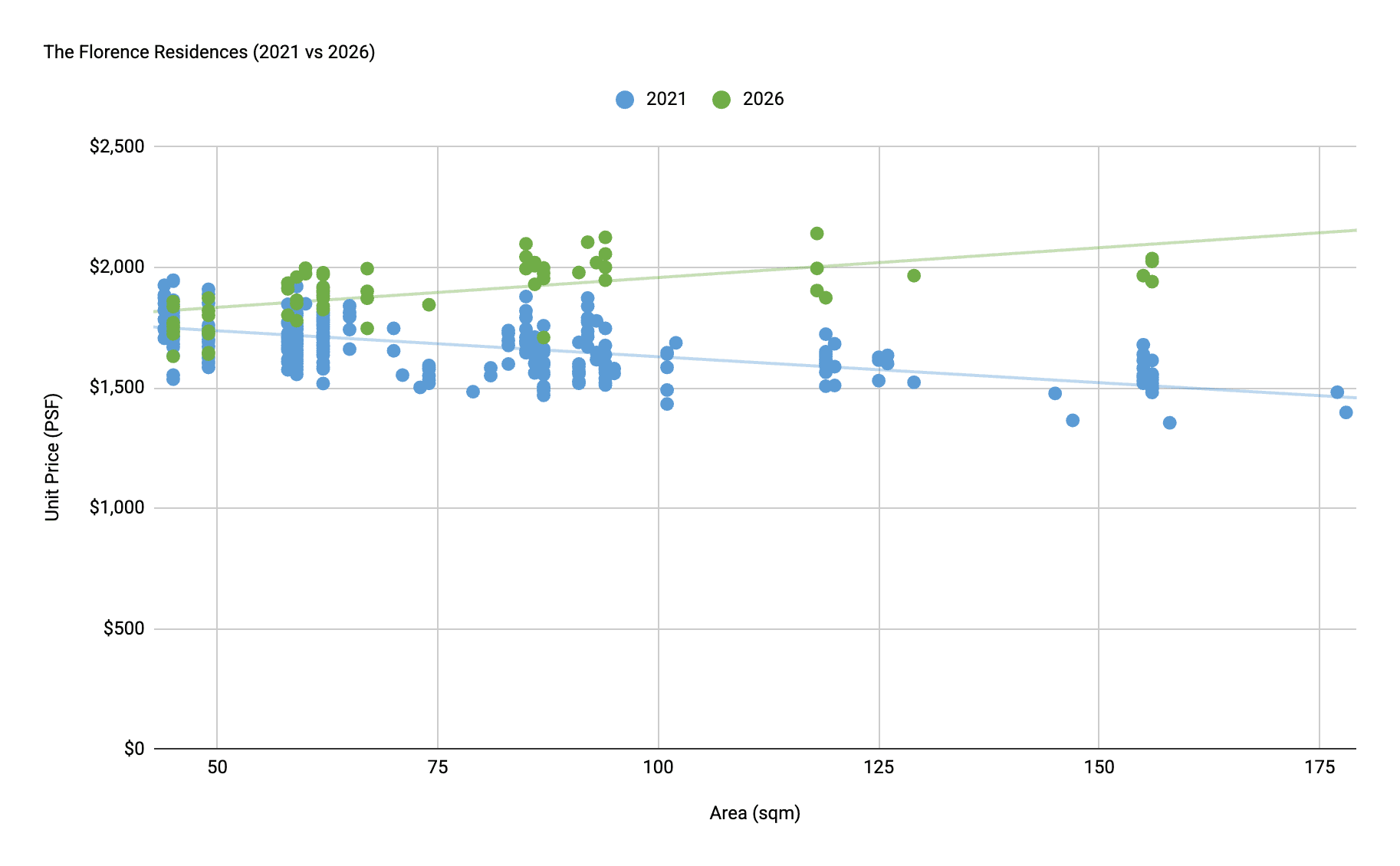
Let’s take a look at these 2 developments: Treasure at Tampines and Florence Residences.
Treasure at Tampines
Located in District 18, Treasure at Tampines is currently the largest condominium development in Singapore. Completed in 2023, the development comprises of 2,205 units and has a 99-year leasehold tenure. With layouts ranging from one-bedroom to five-bedroom units, the development caters for property owners with varying space requirements.
The Florence Residences
Located in District 19, this condominium boasts 128 facilities for residents to enjoy. Also completed in 2023, this development is relatively large, with a total of 1,410 units.
Similar to Treasure at Tampines, there are units that range from one-bedroom to five-bedroom.
What could have influenced this behaviour
Land scarcity
Singapore has a total land area of 744.3 km2, of which over 40% of the area is covered by greenery, such as parks, reservoirs and nature reserves. While not all of this land is protected from development, Singapore has made a concerted effort to conserve and expand its green spaces, as it balances the competing needs of housing, infrastructure and economic development.
With fewer areas available for development and existing sites becoming more expensive to redevelop, Singapore’s land scarcity places an inherent premium on space. As living space becomes much harder to create, buyers may increasingly value not just where they live, but also how much space they have to live in.
Longer holding periods
Policies such as Minimum Occupation Period (MOP) and Seller’s Stamp Duty (SSD), were set up to discourage short-term property transactions and speculative buying. For private property owners, selling within the applicable SSD holding period can incur additional stamp duty. On the other hand, HDB and EC owners are generally restricted from selling their property before fulfilling the applicable MOP. HDB and EC owners may also face severe penalties such as hefty fines.
With longer holding periods, buyers may also be more inclined to view the property as a home they will be living in for years, rather than simply an investment asset.
ABSD
The everyday Singaporean may be more inclined to concentrate their resources on a single property, due to the large upfront cost needed to purchase a second property.
Due to the added upfront cost of owning multiple properties, buyers may place greater importance on choosing a home that can accommodate their needs over the longer term, which can also include having sufficient space.
Therefore, when buyers view a property as a life asset rather than purely an investment, their priorities naturally shift. Instead of focusing on factors like rental yield or capital appreciation, space becomes a much larger factor when considering the property. Liveability can become one of the main considerations, whether there is enough space for a growing family, a home office or simply comfort.
Consultant Insight
So, do bigger units still mean lower PSF?
Traditionally, yes.
However, our analysis suggests that this relationship may no longer be as straightforward as it once was. Analysing the market and specific developments, larger units have started to show PSFs comparable to, and in some cases higher than, their smaller counterparts.
Our TDLR? Space is only one of the many factors that determine what a property is worth to a buyer. Various factors, including location and affordability, all continue to matter.
If you need help navigating home loan decisions, or just another perspective, our consultants are here to assist you.
Frequently Asked Questions
Do larger condo units always have a lower PSF in Singapore?+−
Not necessarily. While larger units have traditionally tended to command a lower PSF, our analysis of private residential transactions from 2021 to 2026 suggests that this relationship is not always consistent. For some larger unit sizes and developments analysed, median PSFs were comparable to or higher than those of smaller units.
Is a lower PSF always better when buying a property?+−
A lower PSF can be useful when comparing properties, but it does not necessarily mean that a property offers better value. Buyers should also consider the overall price quantum, location, tenure, unit characteristics and their purpose for purchasing the property.
Should I consider price quantum or PSF when buying a property?+−
Both are useful measures. PSF helps you understand how a property is priced relative to its size, while price quantum represents the total amount you are committing to the purchase. Your affordability, financing needs and purpose of purchase should therefore be considered alongside both measures.
How can I determine what property price I can afford in Singapore?+−
Your affordability depends on factors such as your income, existing debt obligations, available cash and CPF, and applicable financing limits. A mortgage calculator Singapore buyers can use can provide an estimate of monthly repayments, while a TDSR calculator can help assess how your debt obligations may affect your borrowing capacity.
How do home loan interest rates affect property affordability?+−
Home loan interest rates affect both your monthly mortgage repayments and the overall cost of financing a property. Even when two buyers purchase properties at the same price quantum, differences in their mortgage rates, loan tenure and packages can result in different financing costs.
Should I compare mortgage rates in Singapore before buying a property?+−
Yes. Buyers can compare mortgage rates in Singapore to understand the financing options available across different banks. However, the lowest headline rate may not necessarily be the most suitable package, as factors such as lock-in periods, rate structure and package conditions should also be considered.