|
Lowest Interest Rate
|
|
as of 24 Apr 2026
|
|
|
Are larger units really better value?
|
|
|
|
Would you spend $100 to get a 15% discount, or $200 to get a 20% discount?
|
|
Most people assume that buying more means paying less per unit - the classic "bulk discount" effect - and property has traditionally worked the same way.
|
|
Smaller units usually come with a higher price per square foot (PSF), while larger units tend to have a lower PSF.
|
|
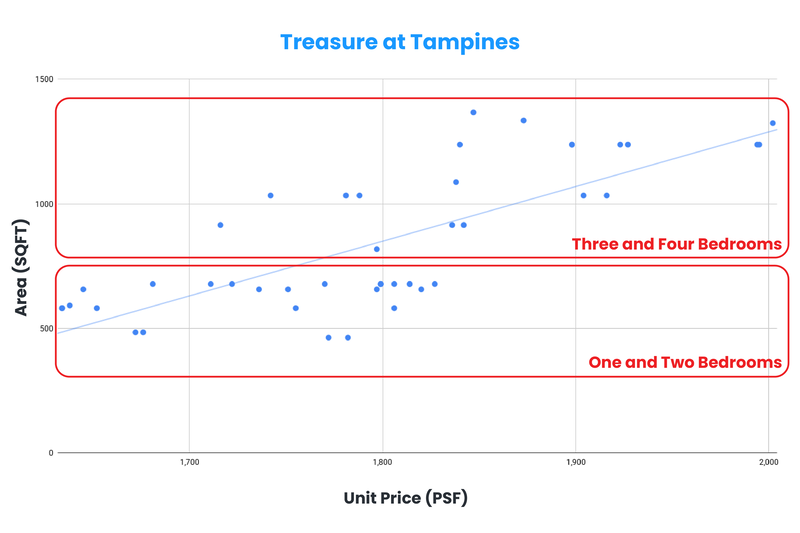
However, we are seeing a shift in the market, and it is becoming more prevalent that larger homes do not equal lower PSF.
|
|
Why is this happening? The answer lies in the shift in price quantum and buyer behaviour.
|
|
|
|
No, we are not talking about Yeezy's QNTM sneakers, but how buyers evaluate a property based on its overall affordability.
|
|
|
|
In property, "quantum" refers to the total purchase price of a home, not just its PSF.
|
|
|
|
For example:
|
| Unit | Size / PSF | Total Quantum |
|---|
| Unit A | 500 sqft, $2,000 PSF | $1,000,000 | | Unit B | 1,000 sqft, $1,700 PSF | $1,700,000 |
|
|
|
|
Even though Unit B has a lower PSF, the actual financial commitment is higher, and this is where buyer behaviour changes.
|
|
|
|
Traditionally, before ABSD was introduced, smaller units attracted investors because of lower entry prices. They could purchase two smaller units at the price of one bigger unit, even if they were paying a higher premium on a PSF basis.
|
|
|
|
Today, that relationship is changing.
|
|
|
|
Before ABSD, smaller units attracted stronger investor demand due to lower entry prices, rental income, and portfolio diversification. As a result, smaller units commanded a higher PSF, and larger units had better value because of their lower PSF.
|
|
|
|
With ABSD, second and subsequent property purchases became significantly more expensive, and the ability to own multiple investment properties has been reduced. Along with land constraints and rising land costs, buyers are more likely to concentrate their budget into a single primary home.
|
|
|
|
This shifts demand from investment-driven purchases to owner-occupied decisions. Owner-occupiers prioritise very different things, such as space and long-term suitability, especially after COVID-19. This need for space drove up demand for bigger homes.
|
|
|
|
While this shift is not as prominent in new launches, we are seeing it emerge in the resale market, particularly in projects like Treasure at Tampines and Florence Residences.
|
|
|
|
One of Singapore's largest condominium developments, located between Tampines and Simei MRT.
|
|
|
|
Recent transactions show how this shift is playing out in actual pricing. Some larger homes are holding comparable, or even stronger, PSF values, reflecting how buyer priorities have changed in today's market.
|
|
|
|
What this means for buyers
|
|
|
|
The old assumption that larger units have lower PSF may no longer hold true. With more buyers prioritising space, larger homes are seeing stronger demand than before.
|
|
|
|
Instead of looking at PSF alone, buyers should evaluate the total financial commitment, future flexibility, and whether the property truly fits their long-term plans.
|
|
|
|
In today's market, the better purchase is not always the one with the lower PSF - it is the one that makes the most financial sense for you.
|
|
|
|
Not sure what you can comfortably afford? Speak to our mortgageplus consultants for personalised guidance.
|
|
|
|